
Peer Reviewed Articles
-
"Is migrant essential worker housing the key to systemic resilience during ongoing polycrisis? Learning from the variegated housing experiences and precarities of UK-based EU migrants during Covid-19 and Brexit"
Gawlewicz, A., Piekut, A., Gilmour, M. and Wright, S., 2026. Is migrant essential worker housing the key to systemic resilience during ongoing polycrisis? Learning from the variegated housing experiences and precarities of UK-based EU migrants during Covid-19 and Brexit. International Journal of Housing Policy, pp.1-40.
Health and socio-political crises combined during the Covid-19 pandemic and Brexit (the UK’s exit from the European Union) impacting the housing experiences of migrant essential workers. Major new research funded by the UK Economic and Social Council generated three datasets: an online survey (n = 1,105) and interviews with 40 UK-based Polish essential workers and 10 stakeholders. The sequential exploratory mixed-methods analysis reveals housing precarity as the missing link in understanding systemic resilience during times of ongoing polycrisis. We find housing precarity is not only intersectionally differentiated and compounded for individual migrants but also creates society-wide vulnerabilities that undermine the labour market, economy and society. Essential workers whose financial situation worsened, job changed and/or employment was part-time were disproportionately affected. Youth, especially men with lower education, limited access to social security and insecure immigration status were particularly associated with moving home. Overcrowding was problematic because of housemates and landlords, with shared private rental accommodation exposing essential workers to health risks. Lack of access to green space was the element of housing precarity most clearly connected with worsening mental health. Better housing outcomes in Scotland imply that localised approaches in other countries might support essential work even within broader hostile immigration policy contexts.
-
"Multi-Hazards and Household Preparedness Planning: Evidence, Gaps and Opportunities"
Gilmour, M., McGowran, P., Gill, J. and Taylor, F., 2025. Multi-Hazards and Household Preparedness Planning: Evidence, Gaps and Opportunities. EGUsphere, 2025, pp.1-31.
This paper presents a systematic analysis of peer-reviewed evidence on household preparedness and multi-hazard interrelationships, identifying what constitutes an effective preparedness plan and assessing how far current research integrates multi-hazard thinking. A systematic search of literature published since 2006 yielded 138 relevant studies, assessed by geographical focus, methodological approach, alignment with best practice, and engagement with multi-hazard perspectives. Fifty papers underwent in-depth qualitative analysis. Findings reveal a persistent Global North and quantitative bias in the evidence base: only 18 % of case studies originate from low- and middle-income countries, and 66 % employ solely quantitative methods. Current understandings of preparedness are therefore narrow, often excluding from low-resource contexts. From the in-depth analysis, we identify key elements of effective household preparedness planning in low-income settings, including shared assets and gender norms. We further show that 45 % of studies focus on a single hazard, with limited attention to hazard interrelationships; 62 % make no explicit reference to how multiple hazards interact to shape preparedness strategies. We conclude with recommendations for future household preparedness research that (a) adopts a broader definition of the term ‘household’, (b) considers gender, (c) considers the barriers to adoption of preparedness plans, (d) embraces qualitative and mixed-methods approaches and (e) considers multi-hazard interactions between hazards and preparedness strategies. The paper advances understanding of the limited maturity of multi-hazard preparedness research and highlights the need for evidence that links household-level practice with Priority 4 of the Sendai Framework for Disaster Risk Reduction 2015–30 and the mid-term call for inclusive, multi-hazard risk governance.
-
“If You Do Not Take the Medicine and Complete the Dose… It Could Cause You More Trouble"
Virhia, J., Gilmour, M., Russell, C., Mutua, E., Nasuwa, F., Mmbaga, B.T., Mshana, S.E., Dunlea, T., Shirima, G., Seni, J. and Lembo, T., 2023. “If You Do Not Take the Medicine and Complete the Dose… It Could Cause You More Trouble”: Bringing Awareness, Local Knowledge and Experience into Antimicrobial Stewardship in Tanzania. Antibiotics, 12(2), p.243.
Antimicrobial resistance (AMR) is a global health issue disproportionately affecting low- and middle-income countries. In Tanzania, multi-drug-resistant bacteria (MDR) are highly prevalent in clinical and community settings, inhibiting effective treatment and recovery from infection. The burden of AMR can be alleviated if antimicrobial stewardship (AMS) programs are coordinated and incorporate local knowledge and systemic factors. AMS includes the education of health providers to optimise antimicrobial use to improve patient outcomes while minimising AMR risks. For programmes to succeed, it is essential to understand not just the awareness of and receptiveness to AMR education, but also the opportunities and challenges facing health professionals. We conducted in-depth interviews (n = 44) with animal and human health providers in rural northern Tanzania in order to understand their experiences around AMR. In doing so, we aimed to assess the contextual factors surrounding their practices that might enable or impede the translation of knowledge into action. Specifically, we explored their motivations, training, understanding of infections and AMR, and constraints in daily practice. While providers were motivated in supporting their communities, clear issues emerged regarding training and understanding of AMR.
-
"How about asylum seekers who are homeless?” State designed strategies of containment during Covid-19 and anti-racist alternatives: a Glasgow case study
Piacentini, T., Gilmour, M., Joy, A. and Aksu, P., 2022. “How about asylum seekers who are homeless?” State designed strategies of containment during Covid-19 and anti-racist alternatives: a Glasgow case study. International Journal on Homelessness
This paper asks two questions: How has the Covid-19 pandemic been experienced by people seeking asylum who are subjected to United Kingdom (UK) State designed-in destitution? And what might be the alternatives to State produced destitution? To answer these questions, we draw on two case studies from Glasgow, a city unique in the UK for its long history of asylum dispersal and its deeply embedded ecology of third-sector support and asylum advocacy work. We argue that to understand the segregatory power of dispersal and tiered welfare provision as forms of violent migration governance, centring the racialised logics at play is imperative. This provides the framework for developing anti-racist approaches to supporting people made homeless through destitution by design. Using case studies, we explore how the UK Government’s use of ‘emergency hotel accommodation’ for people seeking asylum who are already homeless or are at risk of homelessness, are becoming normalised strategies of containment for racialised others and an extension of the distributed violence of dispersal accommodation that long pre-dates the pandemic. We offer an alternative advocacy-led and rights-based approach to secure refuge for people made homeless by the State.
https://ojs.lib.uwo.ca/index.php/ijoh/article/view/14969 Open Access
-
"Navigating Ethical Tensions in Humanitarian Medicine "
PrePrint
Humanitarian medical projects are designed as temporary interventions, focused on rapid response and adaptable closure based on shifting crises. However, the impact of closing such projects, especially on non-communicable disease (NCD) care in conflict-affected settings, is rarely examined from both patient and staff perspectives. This article explores how national staff navigate the ethical challenges of medical humanitarianism and the tension between humanitarian principles and biomedical ethics during project closure. Through an examination of an international humanitarian paediatric thalassemia unit (2018–2023), I examine national staff experiences of power dynamics, continuity of patient care, and the ethical challenges of withdrawal. Based on four years of participatory ethnography-by-proxy, findings reveal how hierarchical decision-making fosters moral distress by association among national staff. Using inductive sociological analysis, this article highlights the ethical and emotional tolls on national staff, who mediate between affected families and inequitable power structures. These insights underscore the need for continuity-focused, localized approaches in humanitarian NCD care, proposing recommendations to better align organisational practices with the realities faced by national staff and their thalassemia patients. This work advances discussions on localization, advocating for more equitable, context-sensitive humanitarian healthcare frameworks.
-
"A Chronicle of Crises and Emergencies: (Dis-)continuity of care for Syrian Refugee Children with Neglected Non-communicable Diseases in Lebanon"
Gilmour, M., Bou-Orm, I.R. Confl Health19, 31 (2025). https://doi.org/10.1186/s13031-025-00670-4
Lebanon’s recent history has been marked by intersecting crises, including a severe economic collapse, the Beirut port explosion, and the COVID-19 pandemic. Amidst this “polycrisis,” the healthcare system has become increasingly reliant on international humanitarian assistance. This paper examines how these overlapping crises have affected the provision of care for children with thalassemia, a neglected non-communicable disease (NCD), within a Médecins Sans Frontières (MSF) paediatric unit operating in Lebanon between 2018 and 2023. Drawing on a single-case study design, the research explores the dynamics of power between state and non-state actors as well as within international humanitarian organizations and their approaches to healthcare delivery. The study employed a mixed-methods approach, including audio diaries, interviews, document analysis, and co-development groups involving 11 staff members and 18 caregivers of Syrian paediatric patients. Participants shared insights into operational challenges, decision-making processes, and the lived experiences of navigating Lebanon’s collapsing health system. Findings reveal three interconnected issues: (1) the polycrises created an unsustainable environment even for resource-rich international non-governmental organizations (iNGOs); (2) the withdrawal of humanitarian services exacerbated the suffering of structurally marginalized Syrian families reliant on no-cost thalassemia treatment; and (3) national staff experienced profound professional and personal challenges as navigated tensions between iNGO policies and patient needs, often leading to burnout and reduced well-being. The study underscores the need for a reorientation of humanitarian healthcare models in protracted crises. This includes greater equity in decision-making between international organisations and national actors, longer-term planning for chronic disease care, and deeper engagement with national staff and affected communities. Prioritising sustainability, health justice, and the lived realities of both providers and patients is essential. While rooted in the specific context of Lebanon’s highly privatised and pluralistic health system, these findings hold broader relevance for fragile settings facing similar structural and political constraints.
Book Chapters
-
Challenges of language, accessibility, and ethics when conducting digital interviews in the virtual space
Piacentini, T., Mirza, N., & Gilmour, M. (2022). Challenges of language, accessibility, and ethics when conducting digital interviews in the virtual space. In SAGE Research Methods Cases.
Qualitative interviews are embedded within a diverse ethical and practical landscape which needs to be managed, navigated, and re-negotiated throughout the research endeavor. This landscape becomes much more complex and multilayered when the research environment has been shifted from in-person face-to-face to the virtual space, particularly in the era of COVID-19. While methodological literature exploring online interviews provides how-to guides in designing and maneuvering the research process, language is rarely attended to, particularly the messiness of doing social research with speakers of a nondominant language. Using the multimethod qualitative research project, Scotland in Lockdown, this case study aims to focus on three aspects: (i) digital interviews in virtual spaces; (ii) making language visible in interviews; and (iii) ensuring language accessibility in the digital context. While aiming to develop a digital research design that ensured participation is inclusive, accessible, and dignified, the Scotland in Lockdown project was not without its methodological challenges. In this case study, we argue that online multilingual research increases accessibility, inclusivity, and affords research opportunities that centralize the voices of the vulnerabilized in society. In doing so, the hierarchy and power dynamics omnipresent within qualitative research can be more readily sidestepped. However, we proceed with caution, recognizing this as a demanding endeavor, both ethically and practically. Digital poverty, exclusion, poor internet connection, and ensuring voices and meaning are not lost in translation cannot be overlooked. If not approached cautiously and carefully, we risk reinforcing the limitations and silences we hoped to evade.
Media and Commentary
-
Safe in Scotland: A pandemic-era alternative to institutional asylum accommodationx`
This blog explores how, in the city of Glasgow, one organisation has been working since 2011 to prevent homelessness among this community of people refused asylum. Safe in Scotland, (originally named Glasgow Night Shelter for Destitute Asylum Seekers) was founded as an urgent humanitarian intervention.
Cite as: Joy, A., Piacentini, T., Gilmour, M., & Aksu, P. (2022). Safe in Scotland: A pandemic-era alternative to institutional asylum accommodation.
Available at: https://rli.blogs.sas.ac.uk/2022/09/02/safe-in-scotland-a-pandemic-era-alternative-to-institutional-asylum-accommodation/
-
Destitution, hotels, and pandemic responses to asylum housing in Glasgow, Scotland
This blog explores Glasgow’s unique position in the UK and how it responded to asylum housing in the pandemic. Glasgow is Scotland’s largest city and has, since 1999, also been the UK Home Office’s largest and only Scottish dispersal area. Dispersal is a system of accommodation that distributes people seeking asylum across the UK on a no-choice basis. When people seeking asylum are dispersed, they are provided with basic accommodation and meagre financial support while their claims are assessed. Combined with the removal of the right to work and to access mainstream welfare, as well as an extended decision-making process on asylum claims, this set-up produces isolation and perpetuates poverty.
Cite as: Gilmour, M., Aksu, P., Piacentini, T. and Joy, A., 2022. Destitution, hotels, and pandemic responses to asylum housing in Glasgow, Scotland.
-
What constitutes a ‘positive’ contraceptive experience?
CERT (Contraception Education Reform Team) are a student-led policy research group based at the University of Edinburgh. We aim to improve contraceptive care and education for all contraceptive users through research and policy-based change. Our research team, comprising of multidisciplinary university students from across the UK and Europe, was recently tasked with researching ‘what constitutes a positive contraceptive experience?’.
Cite as: Gilmour, M. et al. (2021). What constitutes a ‘positive’ contraceptive experience? British Medical
Journal Sexual & Reproductive Health Blog
Available at: https://blogs.bmj.com/bmjsrh/2021/10/08/what-constitutes-a-positive-contraceptive-experience/
-
How to end well: Humanitarians must better plan their exits
Humanitarian aid has an exit problem. Funding cuts have left communities feeling abandoned, but today’s financial crisis is not the first time humanitarian doors have been shuttered overnight.
Muñoz Beaulieu, I., Gilmour, M., Gatter, M., Khattak, Q., Hossain, P., Hendriks, E. and Akdede, N. (2026) How to end well: Humanitarians must better plan their exits. The New Humanitarian, 1 June.
Available at: https://www.thenewhumanitarian.org/opinion/2026/06/01/humanitarians-must-better-plan-their-exits
-
Migrant workers’ housing matters for systemic resilience during crises
Housing insecurity among migrant essential workers is a missing link in maintaining systemic resilience – our study finds.
By Dr Anna Gawlewicz, Senior Lecturer (University of Glasgow), Dr Aneta Piekut, Senior Lecturer in Quantitative Social Sciences (University of Sheffield), Dr Molly Gilmour, Research Associate (Newcastle University) and Prof. Sharon Wright, Professor of Social Policy (University of Glasgow)
Available at: https://hqm.hqnetwork.co.uk/migrant-workers-housing-matters-for-systemic-resilience-during-crises/
Research Reports
-
Constructing the 'Hospitable Environment' Strategic Challenges, Strategic Opportunities
The research focused on the perceived structural, strategic challenges facing, and potential opportunities awaiting, the third sector in Scotland in addressing the Hostile Environment policy and its consequences. The study had two principal aims. First, to collate views from across the third sector in Scotland, incorporating large, medium and small organisations in order to consult a wide, diverse range of perspectives. Second, to provide greater clarity regarding perspectives on the strategic challenges and opportunities facing the third sector, to support greater collective understanding across the asylum and refugee sector more broadly, identify potential pathways forward, and assist efforts to create a more hospitable environment in Scotland (and beyond), where outcomes are improved for communities of refugees and people seeking asylum.
-
Local Architecture Review: Key findings on vernacular shelter designs, materials and local building practices in Afghanistan.
After nearly 40 years of conflict and displacement, Afghanistan remains one of the world’s most complex humanitarian crisis. Shelter needs of displaced, host, and shock-affected populations remain at the forefront of this crisis with over 6.6 million people in need of Emergency Shelter and Non-food Item (ES/NFI) assistance, according to the Humanitarian Needs Overview for 2021. Of these, 2.9 million are projected to be in need of emergency shelter assistance, 2.2 million in need of transitional shelters, and 5.8 million of shelter repairs or NFI assistance. Previous studies have highlighted how many emergency ES/NFI needs are linked to an overall lack of resilience and heightened vulnerability, where many poor families lack the resources to repair their homes following a major shock, often forcing homeowners into debt that limit their ability to recover. The humanitarian community has taken note of this link, highlighting in the Humanitarian Response Plan that transitional shelter responses can play a critical role in building homeowner resilience and keeping them both out of debt and of other, broader needs.
-
Left out and locked down: impacts of COVID-19 for marginalised groups in Scotland
The research focused on the impact of Covid-19 restrictions (‘lockdown’) for four groups already experiencing exclusion, isolation and marginalisation: people having a disability or long-term health condition (DHC); People involved in criminal justice (CJS); Refugees and people seeking asylum who were at risk of destitution (RAD); People surviving domestic abuse or sexual violence (DASV). • As a rapid research project, the study aims to understand and report on the impacts of Covid-19 restrictions as they are happening, in order to contribute to better responses to it; the analysis presented may be further developed and modified.
Artistic Outputs
-
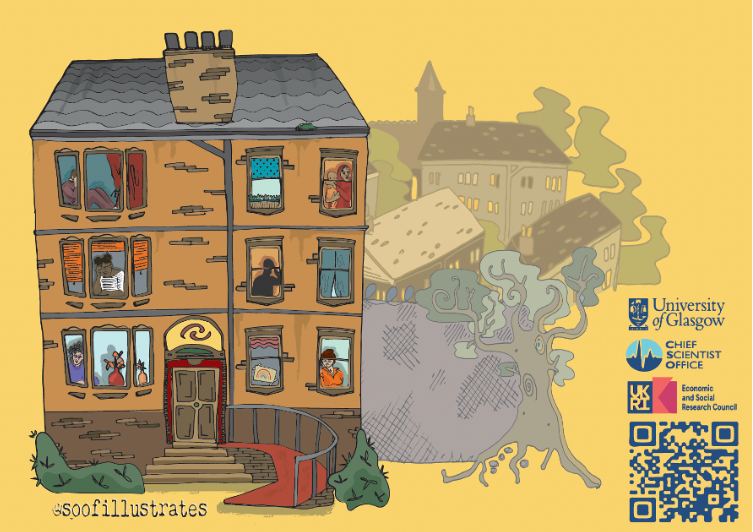
Refugees and Asylum Systems: Illustrated Booklet
In March 2020 Scotland went into lockdown in response to the Covid-19 pandemic. We were all asked to ‘stay at home’, ‘stay safe’ and ‘protect the NHS’, and were told that we were ‘all in it together’. This was not the case for people who were already marginalised and isolated, who faced even more hardship and inequality as a result of the pandemic restrictions. The research team worked collaboratively with ethnographic illustrator Sophia Nelson and many of the project partners to produce powerful graphic novellas that tell the stories of research participants in composite form. Digital and downloadable versions in multiple languages are available at the link below.
Available at: https://scotlandinlockdown.co.uk/graphic-books/
-

How can Humanitarian Aid be improved in Lebanon?
This illustrated collection stems from my PhD research findings. It tells the story of healthcare journeys Syrian parents took, supporting their children’s thalassemia treatment. The art depicts the intimate relationships clinicians, patients and families develop over time.